
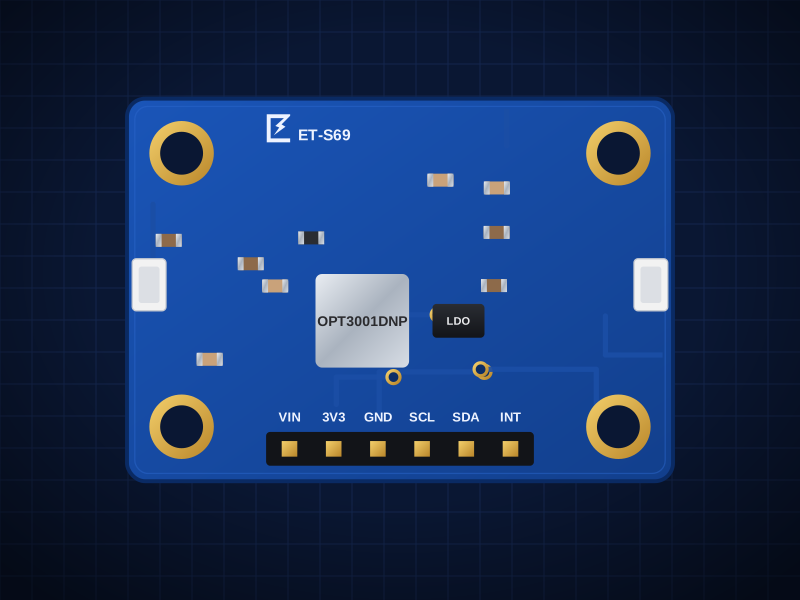
ET-S69
OPT3001 Lux Sensor
Light sensor matched to the human eye, 0.01–83k lux, Qwiic
AED 11.00
Out of stockOverview
Light sensor matched to the human eye, 0.01–83k lux, Qwiic
The ET-S69 is built around the TI OPT3001 — photopic match, IR rejection 99%, 0.01–83 000 lux, 23-bit auto-range. It talks over I2C 0x44 and runs from VIN 3.3–5.5V, LDO.
Two Qwiic / STEMMA QT connectors let you chain it with other boards without soldering, and the 2.54 mm header fits a breadboard.
Designed in Dubai by ElectroTrical — the full schematic, BOM and design notes are published below.
Good for
- Daylight-harvesting lighting control
- Display brightness
- Light logging
Key features
What makes it different
Sensor
TI OPT3001: photopic match, IR rejection 99%, 0.01–83 000 lux, 23-bit auto-range
Interface
I2C 0x44
Supply
VIN 3.3–5.5V, LDO
Libraries
ClosedCube OPT3001, ESPHome opt3001
Qwiic / STEMMA QT
Two JST-SH connectors plus a 2.54 mm header — 3.3 V and 5 V hosts.
Open documentation
Schematic, BOM and layout notes published for every board.
Specifications
Technical specifications
| Sensor | TI OPT3001: photopic match, IR rejection 99%, 0.01–83 000 lux, 23-bit auto-range |
|---|---|
| Interface | I2C 0x44 |
| Supply | VIN 3.3–5.5V, LDO |
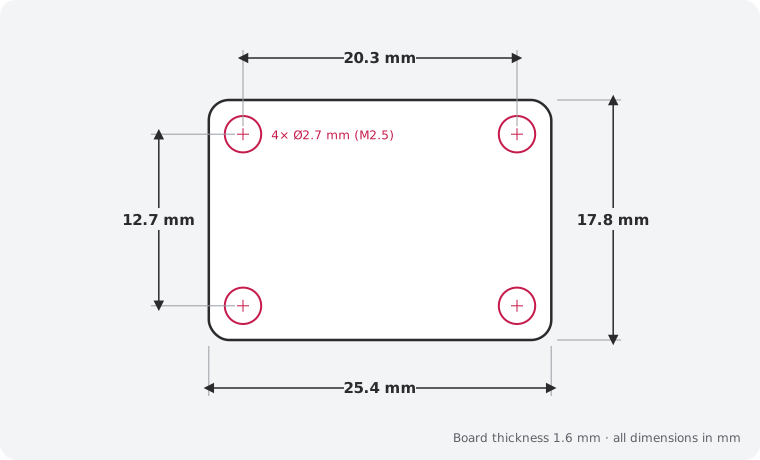
| Size | 25.4 × 17.8 mm |
|---|---|
| Mounting | 4 × M2.5 holes, 2.54 mm from each corner |
| Connectors | 2 × Qwiic / STEMMA QT (JST SH 4-pin) · 6-pin 2.54 mm header |
| Main IC | OPT3001DNPR (LCSC C90462) |
| Revision | Rev A |
| Libraries | ClosedCube OPT3001, ESPHome opt3001 |
|---|
| JP1 (default Closed) | Cut to turn off the LED |
|---|---|
| JP2 (default Closed) | Cut to remove the host-side I2C pull-ups |
Performance
Range
Pinout
Pin map and connections
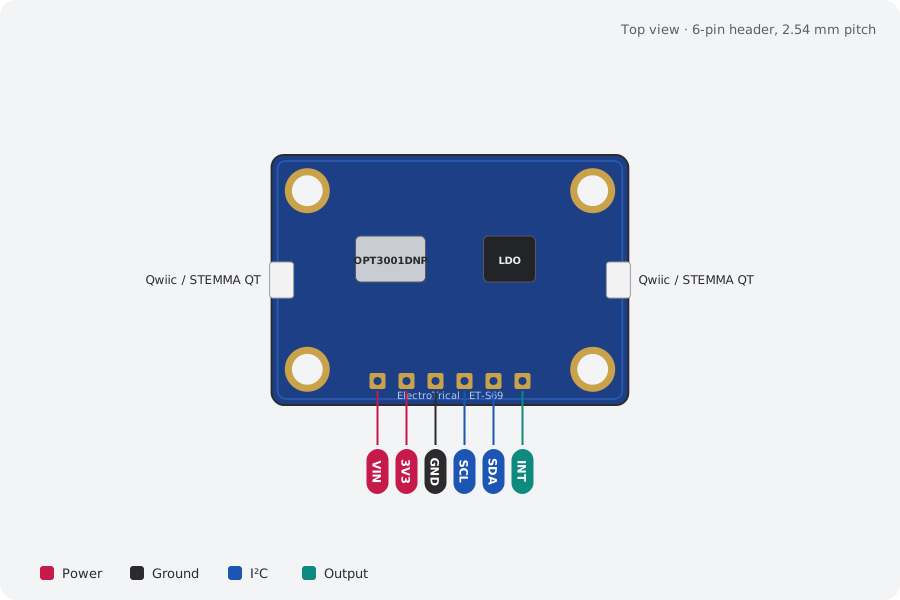
| Pin | Name | Type | Function |
|---|---|---|---|
| 1 | VIN | Power | 3.3–5.5V |
| 2 | 3V3 | Power | LDO output |
| 3 | GND | Ground | Ground |
| 4 | SCL | I²C | I²C clock |
| 5 | SDA | I²C | I²C data |
| 6 | INT | Output | Open-drain interrupt |
Qwiic / STEMMA QT pins: GND, VIN, SDA, SCL (same on both connectors). I²C pull-ups (10 kΩ) are on the board; cut JP2 to remove them.
Mechanical
Dimensions and what's in the box
In the box
- 1 × ET-S69 OPT3001 Lux Sensor (assembled)
- 1 × 6-pin 2.54 mm male header, unsoldered
Getting started
- Plug in a Qwiic / STEMMA QT cable, or solder the header and wire VIN, GND, SDA and SCL
- Libraries: ClosedCube OPT3001, ESPHome
opt3001 - Run an I²C scanner to confirm the address: 0x44
Compare
Which light or proximity sensor?
| OPT3001 Lux Sensor (this board)This board | ET-S65 VCNL4040 Proximity + Light Sensor | ET-S03 VEML7700 Ambient Light Sensor | ET-S56 BH1750 Light Sensor | |
|---|---|---|---|---|
| What it does | Light sensor matched to the human eye, 0.01–83k lux, Qwiic | IR proximity to 20 cm plus ambient light, Qwiic | High-accuracy lux sensor, 0–120k lux, Qwiic | Lux meter from 1 to 65,535 lx, Qwiic |
| Interface | I²C 0x44 | I²C fixed 0x60 | I²C, fixed 0x10 | I²C 0x23 / 0x5C |
| Best for | Daylight-harvesting lighting control | Touchless switches | Auto-brightness for displays | Automatic lighting |
| Price | 11 AED | 25 AED | 15 AED | 14 AED |
Downloads
Documents and design files
Need a custom version of this board?
Different connector, size or sensor? We design and build custom variants.