
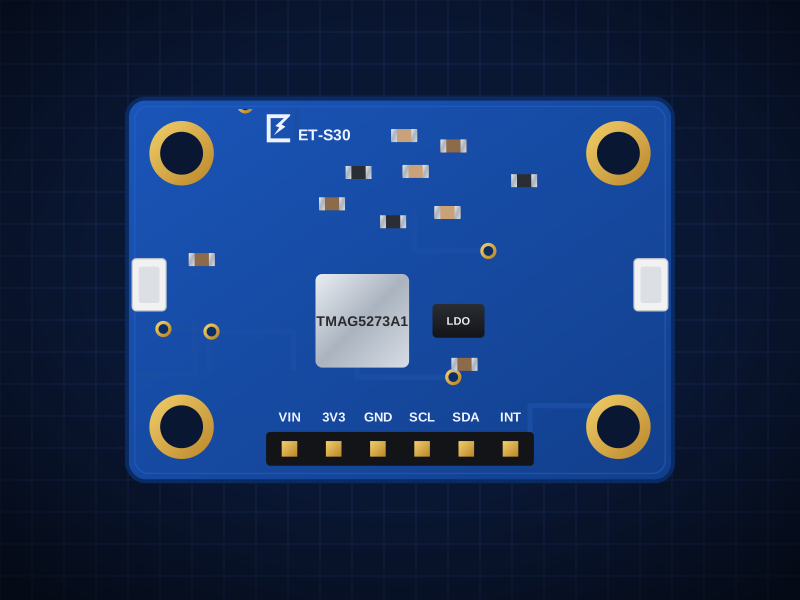
ET-S30
TMAG5273 3D Hall-Effect Sensor
3-axis magnetic position sensor, A1 and A2 versions
AED 19.00
Out of stockOverview
3-axis magnetic position sensor, A1 and A2 versions
The ET-S30 is built around the TI TMAG5273A1 — 3-axis linear Hall, ±40/±80mT, 12-bit, on-chip angle (CORDIC) + temperature. It connects over I²C 0x35 (A1 variant; reprogrammable) (INT) and is powered from VIN 3.3–5.5V, onboard LDO (1.7–3.6V).
Two Qwiic / STEMMA QT connectors let you chain it with other boards without soldering, and the 2.54 mm header fits a breadboard.
Designed in Dubai by ElectroTrical — the full schematic, BOM and design notes are published below.
Good for
- Joysticks and thumb controls
- Contactless knobs and position
- Magnetic switches
Key features
What makes it different
Sensor
TI TMAG5273A1: 3-axis linear Hall, ±40/±80mT, 12-bit, on-chip angle (CORDIC) + temperature
Interface
I2C 0x35 (A1 variant; reprogrammable), INT
Variants
ET-S30-A1: TMAG5273A1 ±40/±80mT (magnets close to the sensor, joysticks) · ET-S30-A2: TMAG5273A2 ±133/±266mT (strong magnets, end-shaft encoders). Same PCB; A2 address 0x22 (verify)
Supply
VIN 3.3–5.5V, onboard LDO (1.7–3.6V)
Qwiic / STEMMA QT
Two JST-SH connectors plus a 2.54 mm header — 3.3 V and 5 V hosts.
Open documentation
Schematic, BOM and layout notes published for every board.
Specifications
Technical specifications
| Sensor | TI TMAG5273A1: 3-axis linear Hall, ±40/±80mT, 12-bit, on-chip angle (CORDIC) + temperature |
|---|---|
| Interface | I2C 0x35 (A1 variant; reprogrammable), INT |
| Variants | ET-S30-A1: TMAG5273A1 ±40/±80mT (magnets close to the sensor, joysticks) · ET-S30-A2: TMAG5273A2 ±133/±266mT (strong magnets, end-shaft encoders). Same PCB; A2 address 0x22 (verify) |
| Supply | VIN 3.3–5.5V, onboard LDO (1.7–3.6V) |
| Size | 25.4 × 17.8 mm |
|---|---|
| Mounting | 4 × M2.5 holes, 2.54 mm from each corner |
| Connectors | 2 × Qwiic / STEMMA QT (JST SH 4-pin) · 6-pin 2.54 mm header |
| Main IC | TMAG5273A1QDBVR (LCSC C3716049) |
| Revision | Rev B |
| Libraries | Adafruit_TMAG5273 / CircuitPython, SparkFun TMAG5273 Arduino, TI reference code |
|---|
| JP1 (default Closed) | Cut to turn off the LED |
|---|---|
| JP2 (default Closed) | Cut to remove the host-side I2C pull-ups |
Performance
Magnetic ranges
Pinout
Pin map and connections
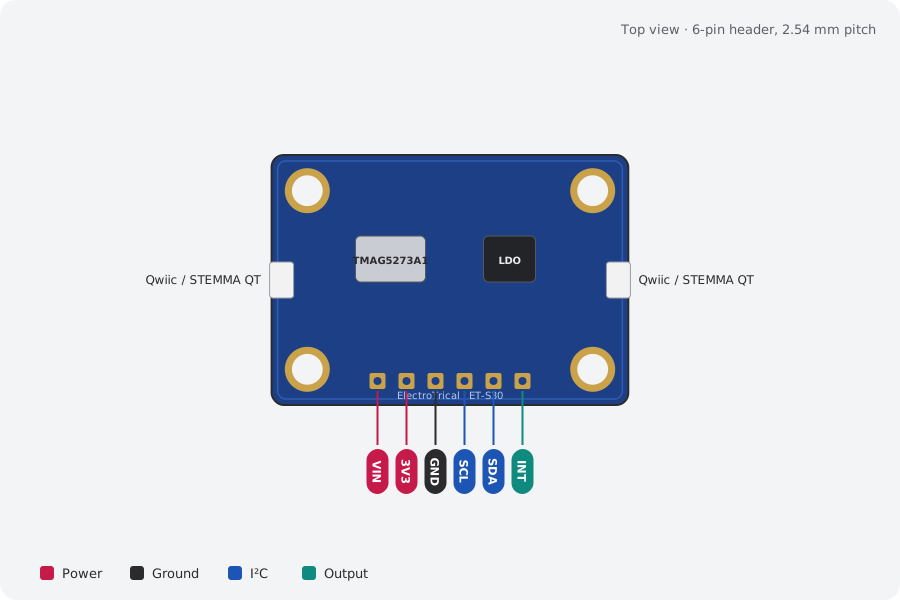
| Pin | Name | Type | Function |
|---|---|---|---|
| 1 | VIN | Power | 3.3–5.5V |
| 2 | 3V3 | Power | LDO output |
| 3 | GND | Ground | Ground |
| 4 | SCL | I²C | I²C clock |
| 5 | SDA | I²C | I²C data |
| 6 | INT | Output | Interrupt, host level |
Qwiic / STEMMA QT pins: GND, VIN, SDA, SCL (same on both connectors). I²C pull-ups (10 kΩ) are on the board; cut JP2 to remove them.
Mechanical
Dimensions and what's in the box
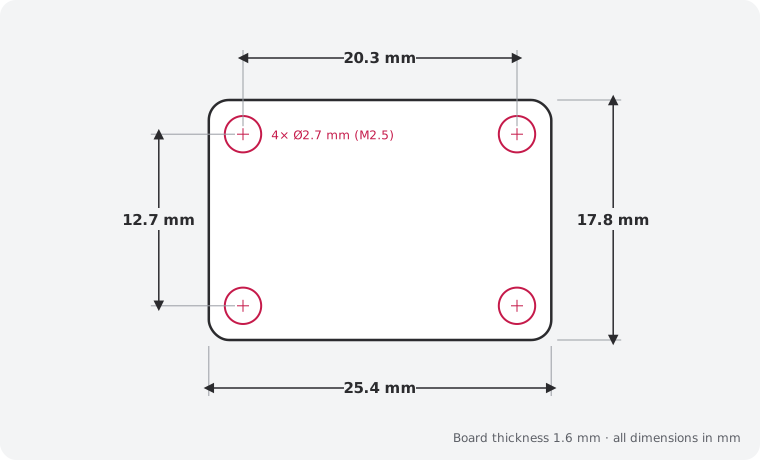
In the box
- 1 × ET-S30 TMAG5273 3D Hall-Effect Sensor (assembled)
- 1 × 6-pin 2.54 mm male header, unsoldered
Getting started
- Plug in a Qwiic / STEMMA QT cable, or solder the header and wire VIN, GND, SDA and SCL
- Libraries: Adafruit_TMAG5273 / CircuitPython, SparkFun TMAG5273 Arduino, TI reference code
- Run an I²C scanner to confirm the address: 0x35
Compare
Which magnetic sensor?
| TMAG5273 3D Hall-Effect Sensor (this board)This board | ET-S31 AS5600 Magnetic Rotary Encoder | ET-S28 MMC5983MA 18-bit Magnetometer | |
|---|---|---|---|
| What it does | 3-axis magnetic position sensor, A1 and A2 versions | 12-bit contactless angle sensor with magnet | Precision 3-axis compass for drones and robots |
| Interface | I²C 0x35 (A1 variant; reprogrammable), INT | I²C fixed 0x36 (AS5600L variant = programmable… | I²C fixed 0x30, INT |
| Best for | Joysticks and thumb controls | Motor and servo position feedback | Drone and rover compass |
| Price | 19 AED | 19 AED | 49 AED |
Downloads
Documents and design files
Need a custom version of this board?
Different connector, size or sensor? We design and build custom variants.