
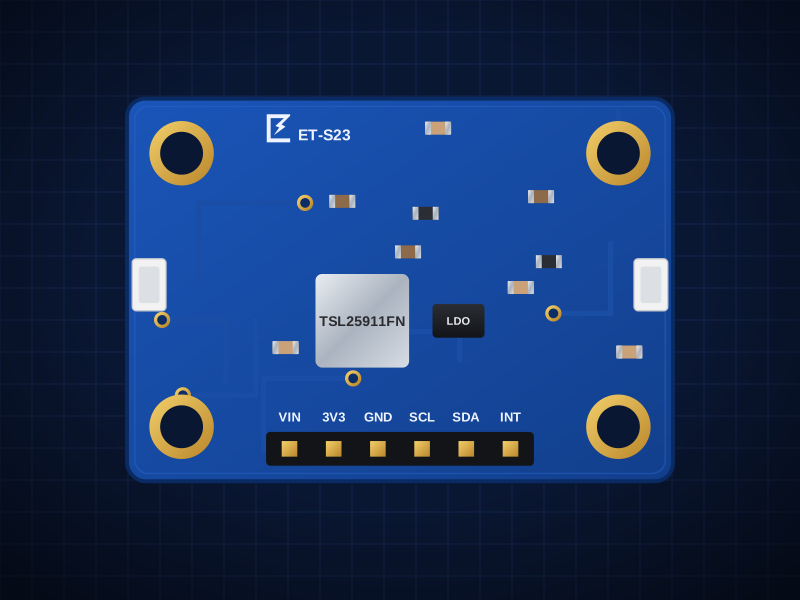
ET-S23
TSL2591 High-Range Light Sensor
188 µlux to 88k lux dynamic range
AED 22.00
Out of stockOverview
188 µlux to 88k lux dynamic range
The ET-S23 is built around the ams TSL2591 — full-spectrum + IR photodiodes, 600M:1 dynamic range, 188µlux–88k lux. It connects over I²C fixed 0x29 (INT) and is powered from VIN 3.3–5.5V, onboard LDO (2.7–3.6V).
Two Qwiic / STEMMA QT connectors let you chain it with other boards without soldering, and the 2.54 mm header fits a breadboard.
Designed in Dubai by ElectroTrical — the full schematic, BOM and design notes are published below.
Good for
- Astronomy sky-quality meters
- Low-light and daylight logging
- Photography light meters
Key features
What makes it different
Sensor
ams TSL2591: full-spectrum + IR photodiodes, 600M:1 dynamic range, 188µlux–88k lux
Interface
I2C fixed 0x29, INT
Supply
VIN 3.3–5.5V, onboard LDO (2.7–3.6V)
Libraries
Adafruit_TSL2591 / CircuitPython, ESPHome tsl2591
Qwiic / STEMMA QT
Two JST-SH connectors plus a 2.54 mm header — 3.3 V and 5 V hosts.
Open documentation
Schematic, BOM and layout notes published for every board.
Specifications
Technical specifications
| Sensor | ams TSL2591: full-spectrum + IR photodiodes, 600M:1 dynamic range, 188µlux–88k lux |
|---|---|
| Interface | I2C fixed 0x29, INT |
| Supply | VIN 3.3–5.5V, onboard LDO (2.7–3.6V) |
| Size | 25.4 × 17.8 mm |
|---|---|
| Mounting | 4 × M2.5 holes, 2.54 mm from each corner |
| Connectors | 2 × Qwiic / STEMMA QT (JST SH 4-pin) · 6-pin 2.54 mm header |
| Main IC | TSL25911FN (LCSC C176812) |
| Revision | Rev B |
| Libraries | Adafruit_TSL2591 / CircuitPython, ESPHome tsl2591 |
|---|
| JP2 (default Closed) | Cut to remove the host-side I2C pull-ups |
|---|
Performance
Gain settings
Pinout
Pin map and connections
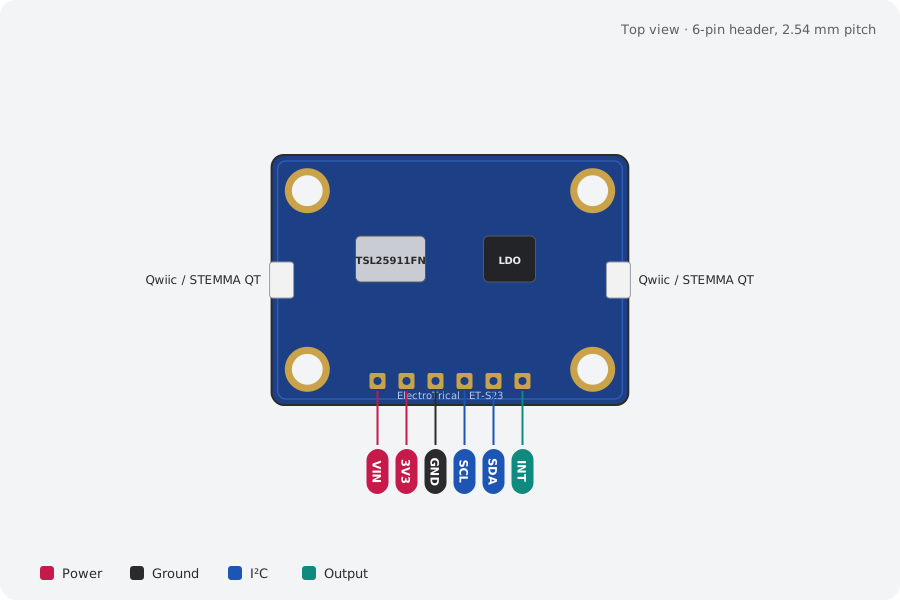
| Pin | Name | Type | Function |
|---|---|---|---|
| 1 | VIN | Power | 3.3–5.5V |
| 2 | 3V3 | Power | LDO output |
| 3 | GND | Ground | Ground |
| 4 | SCL | I²C | I²C clock |
| 5 | SDA | I²C | I²C data |
| 6 | INT | Output | Interrupt, host level |
Qwiic / STEMMA QT pins: GND, VIN, SDA, SCL (same on both connectors). I²C pull-ups (10 kΩ) are on the board; cut JP2 to remove them.
Mechanical
Dimensions and what's in the box
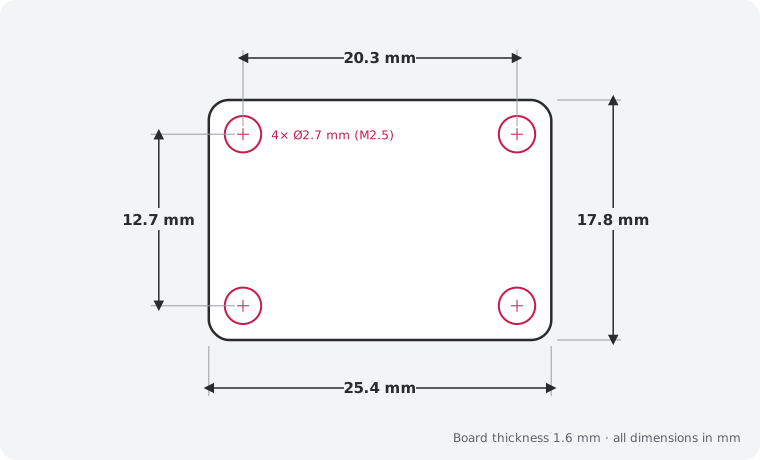
In the box
- 1 × ET-S23 TSL2591 High-Range Light Sensor (assembled)
- 1 × 6-pin 2.54 mm male header, unsoldered
Getting started
- Plug in a Qwiic / STEMMA QT cable, or solder the header and wire VIN, GND, SDA and SCL
- Libraries: Adafruit_TSL2591 / CircuitPython, ESPHome
tsl2591 - Run an I²C scanner to confirm the address: 0x29
Compare
Which light sensor?
| TSL2591 High-Range Light Sensor (this board)This board | ET-S03 VEML7700 Ambient Light Sensor | ET-S17 LTR-390 UV Index Sensor | ET-S24 AS7341 11-Channel Spectral Sensor | |
|---|---|---|---|---|
| What it does | 188 µlux to 88k lux dynamic range | High-accuracy lux sensor, 0–120k lux, Qwiic | UV index plus ambient light over I²C | Visible spectrum in 11 channels over I²C |
| Interface | I²C fixed 0x29, INT | I²C, fixed 0x10 | I²C, fixed 0x53 | I²C fixed 0x39, INT, GPIO (sync) |
| Best for | Astronomy sky-quality meters | Auto-brightness for displays | UV index for weather stations | Colour and spectrum measurement |
| Price | 22 AED | 15 AED | 15 AED | 49 AED |
Downloads
Documents and design files
Need a custom version of this board?
Different connector, size or sensor? We design and build custom variants.