
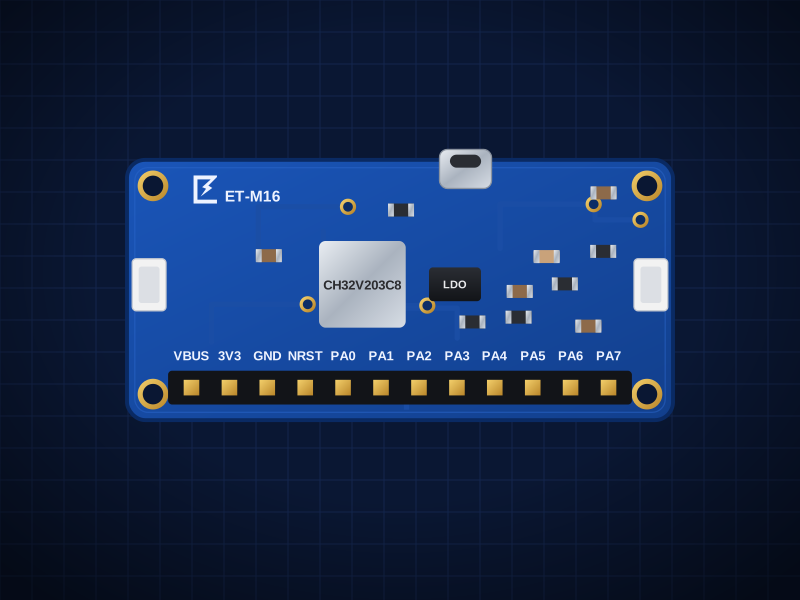
ET-M16
CH32V203 RISC-V Board
144 MHz RISC-V with USB, CAN and 64 KB flash
AED 19.00
Out of stockOverview
144 MHz RISC-V with USB, CAN and 64 KB flash
The ET-M16 is built around the WCH CH32V203C8T6 — RISC-V (QingKe V4B) 144MHz, 64KB flash, 20KB RAM, USB FS device/host, CAN.
Two Qwiic / STEMMA QT connectors let you chain it with other boards without soldering, and the 2.54 mm header fits a breadboard.
Designed in Dubai by ElectroTrical — the full schematic, BOM and design notes are published below.
Good for
- Low-cost USB devices
- CAN experiments
- Learning RISC-V
Key features
What makes it different
MCU
WCH CH32V203C8T6: RISC-V (QingKe V4B) 144MHz, 64KB flash, 20KB RAM, USB FS device/host, CAN
USB
USB-C; ROM USB ISP bootloader (BOOT0 + RESET, WCHISPTool / wchisp)
I/O
18 GPIO on the header, 12-bit ADC, 2-wire debug (WCH-LinkE), Qwiic at 3.3V
Clock
8MHz crystal
Qwiic / STEMMA QT
Two JST-SH connectors plus a 2.54 mm header — 3.3 V and 5 V hosts.
Open documentation
Schematic, BOM and layout notes published for every board.
Specifications
Technical specifications
| MCU | WCH CH32V203C8T6: RISC-V (QingKe V4B) 144MHz, 64KB flash, 20KB RAM, USB FS device/host, CAN |
|---|---|
| USB | USB-C; ROM USB ISP bootloader (BOOT0 + RESET, WCHISPTool / wchisp) |
| I/O | 18 GPIO on the header, 12-bit ADC, 2-wire debug (WCH-LinkE), Qwiic at 3.3V |
| Clock | 8MHz crystal |
| Power | 5V USB-C → AP2112K 3.3V |
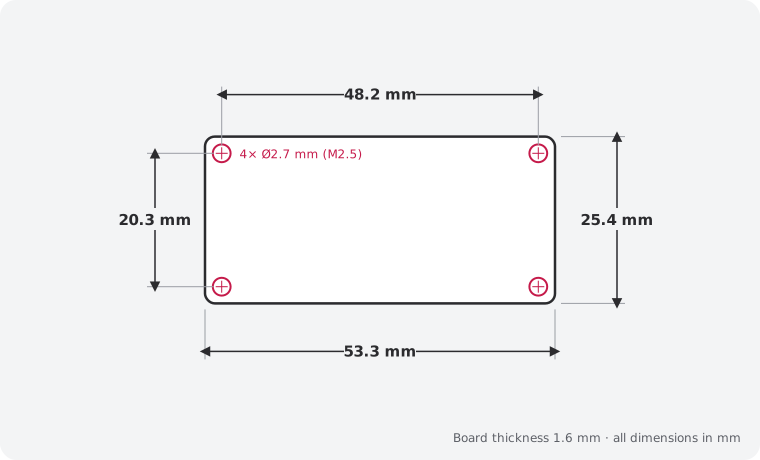
| Size | 53.3 × 25.4 mm |
|---|---|
| Mounting | 4 × M2.5 holes, 2.54 mm from each corner |
| Connectors | 2 × Qwiic / STEMMA QT (JST SH 4-pin) · 22-pin 2.54 mm header · USB-C 16P receptacle (USB 2.0) — USB-C (power + native USB / bridge) |
| Main IC | CH32V203C8T6 (LCSC C3001172) |
| Revision | Rev A |
| Libraries | MounRiver Studio / WCH SDK, Arduino CH32 core, ch32-rs (Rust), PlatformIO |
|---|
Performance
Speed
Pinout
Pin map and connections
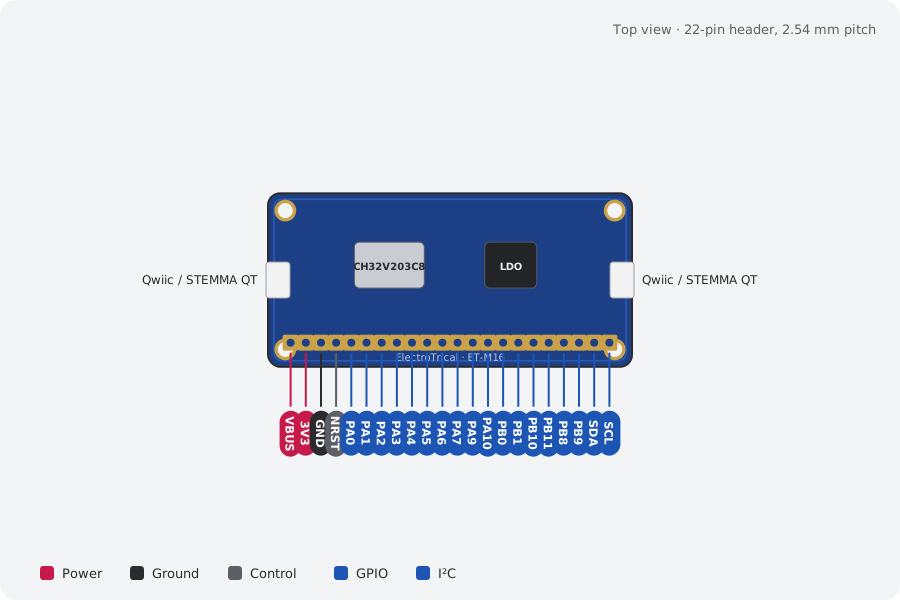
| Pin | Name | Type | Function |
|---|---|---|---|
| 1 | VBUS | Power | 5V from USB-C |
| 2 | 3V3 | Power | 600mA LDO |
| 3 | GND | Ground | Ground |
| 4 | NRST | Control | Reset, active low |
| 5 | PA0 | GPIO | ADC0 |
| 6 | PA1 | GPIO | ADC1 |
| 7 | PA2 | GPIO | USART2_TX |
| 8 | PA3 | GPIO | USART2_RX |
| 9 | PA4 | GPIO | SPI1_NSS |
| 10 | PA5 | GPIO | SPI1_SCK |
| 11 | PA6 | GPIO | SPI1_MISO |
| 12 | PA7 | GPIO | SPI1_MOSI |
| 13 | PA9 | GPIO | USART1_TX |
| 14 | PA10 | GPIO | USART1_RX |
| 15 | PB0 | GPIO | ADC8 / TIM3 |
| 16 | PB1 | GPIO | ADC9 / TIM3 |
| 17 | PB10 | GPIO | I2C2_SCL |
| 18 | PB11 | GPIO | I2C2_SDA |
| 19 | PB8 | GPIO | CAN_RX (remap) |
| 20 | PB9 | GPIO | CAN_TX (remap) |
| 21 | SDA | I²C | PB7 — I²C1 SDA (Qwiic) |
| 22 | SCL | I²C | PB6 — I²C1 SCL (Qwiic) |
Qwiic / STEMMA QT pins: GND, VIN, SDA, SCL (same on both connectors).
Mechanical
Dimensions and what's in the box
In the box
- 1 × ET-M16 CH32V203 RISC-V Board (assembled)
- 1 × 22-pin 2.54 mm male header, unsoldered
Getting started
- Plug in a Qwiic / STEMMA QT cable, or solder the header and wire VIN, GND, SDA and SCL
- Libraries: MounRiver Studio / WCH SDK, Arduino CH32 core, ch32-rs (Rust), PlatformIO
Compare
Which USB microcontroller?
| CH32V203 RISC-V Board (this board)This board | ET-M11 STM32F411 Dev Board | ET-M12 RP2350 Dev Board | ET-M15 SAMD21 Mini Board | |
|---|---|---|---|---|
| What it does | 144 MHz RISC-V with USB, CAN and 64 KB flash | 100 MHz Cortex-M4F with 512 KB flash, USB-C DFU and Qwiic | Dual Cortex-M33 / RISC-V 150 MHz, 2 MB flash, USB-C, Qwiic | 48 MHz Cortex-M0+ with native USB, DAC and Qwiic |
| Interface | — | — | — | — |
| Best for | Low-cost USB devices | DSP and fast control loops | PIO tricks and fast I/O | USB HID devices |
| Price | 19 AED | 19 AED | 49 AED | 23 AED |
Downloads
Documents and design files
Need a custom version of this board?
Different connector, size or sensor? We design and build custom variants.